Monday, January 11, 2016

Bible Study on Luke 3:15-22

  1. First (if you are doing this study soon after), how was your Christmas? Share a special moment, a surprise, or just something that you enjoyed.
  2. Do you have godparents and how, if at all, are they involved in your life today?
  3. Read Luke 3:15-22
  4. In verse 15, do the people know who they are looking for or understand what they are looking for when they are looking for the Christ?
    1. Note: The word, “Christ,” is a Greek translation of the Hebrew word, “Messiah.” A “messiah” is an anointed one, “a person having sacred oil poured ceremonially on one’s head, and so become a person with special authority and function, with the implication of one having the choice and approval of God”[1] The pouring of oil is secondary to the being called of God for a special purpose. Look up the following verses to see uses of the word, “messiah,” in lower context than the ultimate messiah, Jesus of Nazareth:
    2. Leviticus 4:3, a priest is called the “anointed.” This is the Hebrew word, “messiah”
    3. Isaiah 45:1, the Assyrian king, Cyrus, is called the Lord’s anointed. Again, the Hebrew word here is “messiah.”
    4. Psalm 2:2, apparently a prophecy about the messiah who would rule the world.
    5. Acts 2:36, Christians see Jesus’ resurrection as proof that he is, indeed, the “anointed one,” the One set apart by God for special authority and function.
  5. In verse 16, how would you say John perceived the coming Christ? 
    1. For a more detailed account of Jesus’ baptism, including John’s understanding of his role and how he would identify the messiah, read John 1:19-34.
  6. In verse 16, John says the messiah will baptize with the Holy Spirit and with fire.
    1. “Baptism” is a ritual cleansing (with water). What do you think John means by saying the messiah will baptize with the Holy Spirit and with fire?
  7. What kind of activity is symbolized in verse 17?
    1. Verse 17 uses details that would be very familiar to an average person in Jesus’ day. A “winnowing fork” is basically a pitch fork. A “threshing floor” is “a surface of hard dirt or stone, for beating or trampling grain heads.”[2] Trampling the grain breaks the chaff loose. The chaff is the light outer husk of the grain, similar to the thin outer skin of a peanut. After threshing, the grain is tossed into the air with the winnowing fork. The heavier heads of grain fall back to the floor while the light chaff is blown away.
  8. Verse 18 calls John’s message “good news.” How do you understand baptism with fire and threshing to be good news?
    1. It may be helpful to remember that the Promised Land was, at this point, occupied by the Romans. Also, the central narrative of Jewish life is the Exodus, celebrated every year at Passover.
  9. Verses 19-20 are a flash-forward (as opposed to a “flashback”). The Gospel of Luke was probably composed around AD60. These verses are the Luke’s parenthetical comment about what Herod did later.
  10. In verse 21-22, who is Jesus baptized with? What unique thing happens to Jesus?
  11. What else strikes you in this passage?
  12. Close with prayer.
[1] Swanson, J. (1997). Dictionary of Biblical Languages with Semantic Domains : Hebrew (Old Testament) (electronic ed.). Oak Harbor: Logos Research Systems, Inc.
[2] Swanson, J. (1997). Dictionary of Biblical Languages with Semantic Domains: Greek (New Testament) (electronic ed.). Oak Harbor: Logos Research Systems, Inc.

Monday, December 28, 2015

Happy New Year, you amazing, wretched, infinitely loved child of God

January makes me think of beginnings. Beginnings make me think of Genesis 1. Genesis 1 makes me think of the phrase, “God saw that it was good.” It’s repeated over and over until at the very end, after the creation of mankind, God saw that it was “very good.” This is an important point.

Every week in worship we remind ourselves that we are sinners in need of forgiveness. We confess our sins and remind ourselves of the powerful mercy of God shown in the death and resurrection of Jesus Christ. This is as it should be.

But do you remember the reason behind the suffering, death and resurrection of Jesus Christ? The driving force is God’s love for human beings, after whose creation he kicked his rhetoric up a notch, calling the whole thing, “very good," rather than simply calling it, "good," as he did during all the earlier cycles of creation.  You are amazing. Of course we must agree with Isaiah, that all our works are as filthy rags (Isaiah 64:6), but our whole identity is not “filthy rag.” Genesis does not teach us that on the sixth day God created filthy rags.

You, my friend, are the pinnacle of God’s creation and the apple of his eye. You are the object of God’s profound love. The nearest feeling we can probably experience on Earth is the love that adults feel when they hold a baby or as they play with a young child who is delighted because she took her first step. Do you realize that God gushes over you? Most parents, aunts, uncles, etc. have snuck in to watch youngsters sleeping. Do you, old though you may be, realize that God feels that way about you? Can you imagine God sneaking in while you are sleeping just to look at you and smile warmly?

It is the very depth of that love that also grieves God’s heart when we turn away from the good, like a parent’s heart breaks when her son turns away to follow a path the parent knows will end in pain and hardship.

This is how God’s redemptive love comes to its profound and disturbing zenith on the cross. We are his amazing and beloved creation. We have turned away from him. But his heart goes out to us so forcefully that death is not too much to undergo to draw us back to himself. This is how God, in his love, brings down the proud and lifts up the lowly. All are created beautiful. None live worthily. All are offered grace.

So each of us can say, “Wow, look at me!” in wonder, “Wow, look at me, I’m not what I could be,” in grief and, “Wow, look how much God loves me!”

So, you amazing, wretched, infinitely loved child of God, a blessed 2016 to you.

Sunday, December 27, 2015

Gamechangers: Tesla, Jobs, King, Jesus

(This blog post is a condensed transcript of the sermon I preached on Christmas Eve, 2015. If you prefer to listen to or download an audio recording the whole message, you can find it here.)

We hear the word "game-changer" thrown around with some regularity. If a sports team drafts a talented player, that might be a game-changer. If someone enters or exits a political race, that might be a game-changer. While those circumstances might be media selling consumption with hyperbole, some people really can be historically identified as game-changers. Not only has their work altered the course of civilization, they could see where their work could lead.

Nikola Tesla was a brilliant scientist/engineer. In 1926 he said, "When wireless is perfectly applied the whole earth will be converted into a huge brain, which in fact it is, all things being particles of a real and rhythmic whole. We shall be able to communicate with one another instantly, irrespective of distance. Not only this, but through television and telephony we shall see and hear one another as perfectly as though we were face to face, despite intervening distances of thousands of miles; and the instruments through which we shall be able to do his will be amazingly simple compared with our present telephone. A man will be able to carry one in his vest pocket." Does that sound familiar?

Steve Jobs could see a whole different future for computers. He not only changed the way we use computers but he also changed the way we listen to music. When recruiting John Sculley, then CEO of Pepsi, to come and work at Apple, Jobs told him, "Do you want to sell sugar water for the rest of your life, or do you want to come with me and change the world?”

All I have to do is mention Martin Luther King, Jr., and everyone will know exactly what I am about to quote: "I have a dream..."

Jesus of Nazareth, whose birth we celebrate every Christmas, is the ultimate game-changer. He changed the course of history and the course of eternity.

Nobody, however, changes the world on their own — not even Jesus. Nobody can convince you to be a follower of Jesus. The Holy Spirit must convince you. The only thing followers of Jesus can do is talk about Jesus, perhaps share evidence for the reliability of the Bible, love others in Jesus name, and involve prayer.

There is a funny video going around the internet. There is a dog that won't come through a glass door even though there is actually no glass in the frame of the door. The dog has been trained over the years to think that there must be something in that door that will stop him. The people even step through the door without the glass in it but the dog won't follow them. Finally, they open the door and the dog happily walks through.

Life does that to us humans. Because we are trained by authorities and experience, we know "how things are." But, like the dog with the glass door with no glass in the frame, we run the risk of assuming things are different than they really are.

Let me give you some evidence for the fact that God, through the Holy Spirit, is still at work in the world, still changing the game.

In Europe and North America, it is pretty easy to feel like the Christian church is dying. But that is only our limited perspective. In 1945 there were 950,000 Christians in China. Today there are 77 million. 250 churches per week are started in Latin America (with an average of 150 people per church). 50,000 people per week are being baptized in Africa.

And it's not just the faith that is growing in waves around the world, it is the love for others that is the natural outgrowth of faith in Jesus Christ. 25 years ago, 45,000 children per day died of starvation or malnutrition. Today that number is 17,000. Still too many, but a lot less. 25 years ago 80% of the world was illiterate. Today that number is 20%. 25 years ago 1/6 of the world did not have access to clean drinking water. Today that number has been cut in half to 1/12. Habitat for Humanity, founded in 1976, just finished its one millionth home.

There are kind people from all over doing this good work, but statistics will tell you that the vast majority of this work is done by followers of Jesus of Nazareth, that baby whose birthday we celebrate every Christmas.

Jesus is a game-changer. He is the ultimate game-changer because of who he is. The Apostle Paul asserted that the fullness of God is seen in Jesus (Colossians 2:9). The Apostle John asserted that Jesus was the very essence of God come in human flesh (John 1:14). Jesus himself told his disciple, Philip, that looking at Jesus was, in fact, looking at God (John 14:9).

God was enfleshed in Jesus Christ. God continues to live in those who believe in him. Jesus changes how you see yourself, others and the entire world.

The life, death and resurrection of Jesus shows the profound, crazy, tender love that God has for us. In Jesus, God sees us as his precious children. God thinks of us like a parent who quietly walks into a child's room to watch them sleeping just for the sheer joy of it. That's how God thinks of you! Can you believe it?

When you believe that God loves you with that kind of love, it changes the way you see other people. It changes the way you see the entire world. Everything becomes driven by love.

Christmas is an invitation to you to be born again into God's love, to let Jesus change the game of your life.

Christians use the word "repent." This word does not mean just feel bad about something you've done wrong. It means "turn your mind around," "think differently."

We celebrate Jesus not because we have no problems after trusting in him. We celebrate Jesus' birth (along with his life, death and resurrection) because he changes the presupposition of our lives from "Who knows what life is all about?" to "There is a God who loves me and even though I don't understand everything that happens to me, I can always trust God."

Trust Jesus. He will come to you. You will grow to see yourself as God's beloved child.

Trust Jesus. Seriously. It's a game-changer.

Wednesday, December 23, 2015

You're Not Listening! No, I REALLY CANNOT Hear You!

I was scanning through old blog posts recently and ran across this post from March, 2013. As I read through it, little bells began to go off in my head. I thought about how good it was for me to read this post again.

It's about how stressful situations physiologically reduce your ability to think and listen. The upshot is that if things get heated (say in a "discussion" between a husband and wife), a break might very well be needed because our body's stress response reduces our ability to listen and process. It's just a physiological fact. Further, it needs to be longer than a 5 minute break. Research suggests you need at least 20 minutes of doing something totally unrelated in order for your body's stress response to really relax to a point where you can re-engage appropriately.

I'm not going to rewrite the whole post here. But I suggest you go read it. It was good for me and perhaps it will be good for you, too.

http://pjatjol.blogspot.com/2013/03/youre-not-listening-no-i-really-cant.html

--------------------------------------
To view my entire blog, CLICK HERE.

Look to the right toward the top of the blog for links to subscribe to my blog via email or via Networked Blogs.

Tuesday, December 22, 2015

Book Recommendation: "What the Most Successful People Do Before Breakfast" by Laura Vanderkam

This is not a long book (192 pages in print) and it is an easy read... or listen. I listen to audio books while I walk 2-4 miles every morning. Some people like the solitude of an early morning walk. Unless I'm in a particular mood, the quietness drives me crazy. So audio books work for me.

(As an aside, I get most of my audio books from my local public library. They are electronically downloadable and automatically delete from my smart phone when they are due so I never have late fees. Our library also has electronic books for checkout and download (Kindle, etc.) You should check to see if your library has electronic loans.)

Through anecdotal and scientific evidence, Laura Vanderkam shows us what habits seem to be common among successful people. She is not just talking about career or financial success. She presents the first-in-the-morning habits that help people take control of their lives and realize their goals/dreams... success on their terms.

The answer in a nutshell is "self care." The most successful people pretty much all make exercise an nearly inviolable part of their day. Then they feed their mind/spirit through prayer, reading, journaling, meditation, whatever. Some also include relationship maintenance, like having breakfast with the family.

I recommend you read the book. I am not one of  "the most successful people," but I aspire to be and I found this book practical and motivational. I credit this book and "The Power of Habit" with helping me develop a sustainable exercise routine.

What the Most Successful People Do Before Breakfast: A Short Guide to Making Over Your Mornings--and Life (A Penguin Special from Portfolio) by Laura Vanderkam

http://smile.amazon.com/Successful-People-Before-Breakfast-Mornings---ebook/dp/B007K3E2YK/ref=sr_1_2?ie=UTF8&qid=1450793456&sr=8-2&keywords=what+the+most+successful+people+do+before+breakfast

[The link above is to the Amazon Smile page for the book in this recommendation. If you shop at Amazon Smile, a small portion of the proceeds from your purchase will can support the nonprofit organization of your choice. I suggest you choose Journey of Life Lutheran Church. :) ]

For another great book,
CLICK HERE to see my recommendation for "The Power of Habit" by Charles Duhigg

To view my entire blog, CLICK HERE.

Look to the right toward the top of the blog for links to subscribe to my blog via email or via Networked Blogs.

Monday, December 21, 2015

Forget the New Year's Resolutions

Imagine this situation: The doorknob on your front door is dirty. Someone with grimy, greasy hands used the doorknob on Thanksgiving weekend after working in the yard and now every time you walk in your front door you have to wash your hands. So you think to yourself, in the new year, I really will clean this doorknob.

Far fetched?

I may be the New Year's version of Scrooge, but that's what I think we do with New Year's resolutions. We have some bad habit that we admit we need to change — whether it's something we need to start or something we need to stop — and we decide to change it in a few weeks or a few months. We'll change that next year.

Does this make sense?

Let's make up an example that I'm sure applies to almost no one (cough, cough). Let's say I recognize that the way I eat is really not good for me. I eat too much of something or too little of something else. So I decide I need a New Year's resolution.

It strikes me that this might mean you aren't really convinced that your eating needs to change. If you acknowledge that the way you are eating is bad for you in November, then by setting a New Year's resolution you are intentionally saying, "I'm going to eat in ways that will damage my body for two more months and then stop." Those are not the words of someone taking responsibility for their life. Those are the words of the half-convinced.

Seriously. If you think something needs to change, why wait? If it can wait until January 1, 2016, why change it at all?

I'm not diminishing how hard it is to change habits. It can be horribly hard. That might also be what's behind the New Year's resolution. We are looking for tricks to help us do something that we know we need to do but that we also know, if we are willing to admit it to ourselves, is going to be really difficult.

But waiting until January 1 isn't going to make it easier. Find the motivation you need now. Maybe it's pictures of nasty blood vessels and operations. Maybe it's pictures of loved ones. Maybe it's a goal you want to reach. Likely you will need ongoing support and motivation, which is available in abundance on the internet.

One very helpful book that I recommended in a recent blog post is called, "The Power of Habit." (read the blog post here) It can help you understand how habits form and how to change them.

One more thing: some studies have indicated that if you are trying to change a habit in a positive way (as in a New Year's resolution), you are more likely to succeed if you don't tell other people your intentions. The reason appears to be that if you tell people that you are going to, say, start exercising more frequently, you get their approving remarks without actually doing the exercise. So you are putting part of the reward before the behavior, which lowers the likelihood of actually making the change. The exception to this rule is if you are intentionally engaging supportive people for the sake of accountability, as happens in groups such as Weight Watchers. Accountability groups increase your chances of success.

Bah humbug with New Year's resolutions. Just work toward becoming the person you want to be without waiting for an arbitrary starting date. That's what I say. :)

(But I'm not here to judge you. If New Year's resolutions work for you, more power to ya!)

Wednesday, December 16, 2015

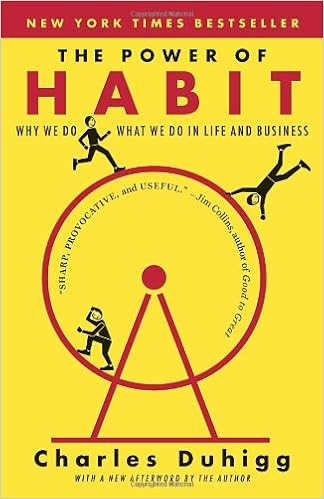
Book Recommendation: "The Power of Habit" by Charles Duhigg

Our lives are made of our habits. The health of our bodies is largely driven by our habits, as is the health of our relationships and our own inner/spiritual life.

"The Power of Habit" isn't a Christian book. It's a book about the science of forming and changing habits. There are some surprising insights into how and why we form and maintain habits. For instance, people with no short term memory can form new habits.

This isn't a "book review." There are good reviews out there about this book. It's a recommendation. This book is an easy and informative read. Some of the ideas presented in "The Power of Habit" may really help you do whatever it is you wish you were doing but aren't.

I've found this book helpful to me personally (primarily) and also for my work as a pastor. I feel like I've developed some pretty good habits for exercising and eating based on this book (and one other, which I will post about soon). BTW - This book doesn't talk about exercising and eating. I've found the principles and actionable suggestions helpful for these two habits I wanted to develop. If your life is largely your habits, what habits do you want to develop?

It's worth checking out. You might find it helpful like I did.

The Power of Habit: Why We Do What We Do in Life and Business  (ISBN-10: 081298160X)

http://smile.amazon.com/Power-Habit-What-Life-Business/dp/081298160X/ref=sr_1_1?ie=UTF8&qid=1450301065&sr=8-1&keywords=the+power+of+habit

[The link above is to the Amazon Smile page for the book in this recommendation. If you shop at Amazon Smile, a small portion of the proceeds from your purchase will can support the nonprofit organization of your choice. I suggest you choose Journey of Life Lutheran Church. :) ]